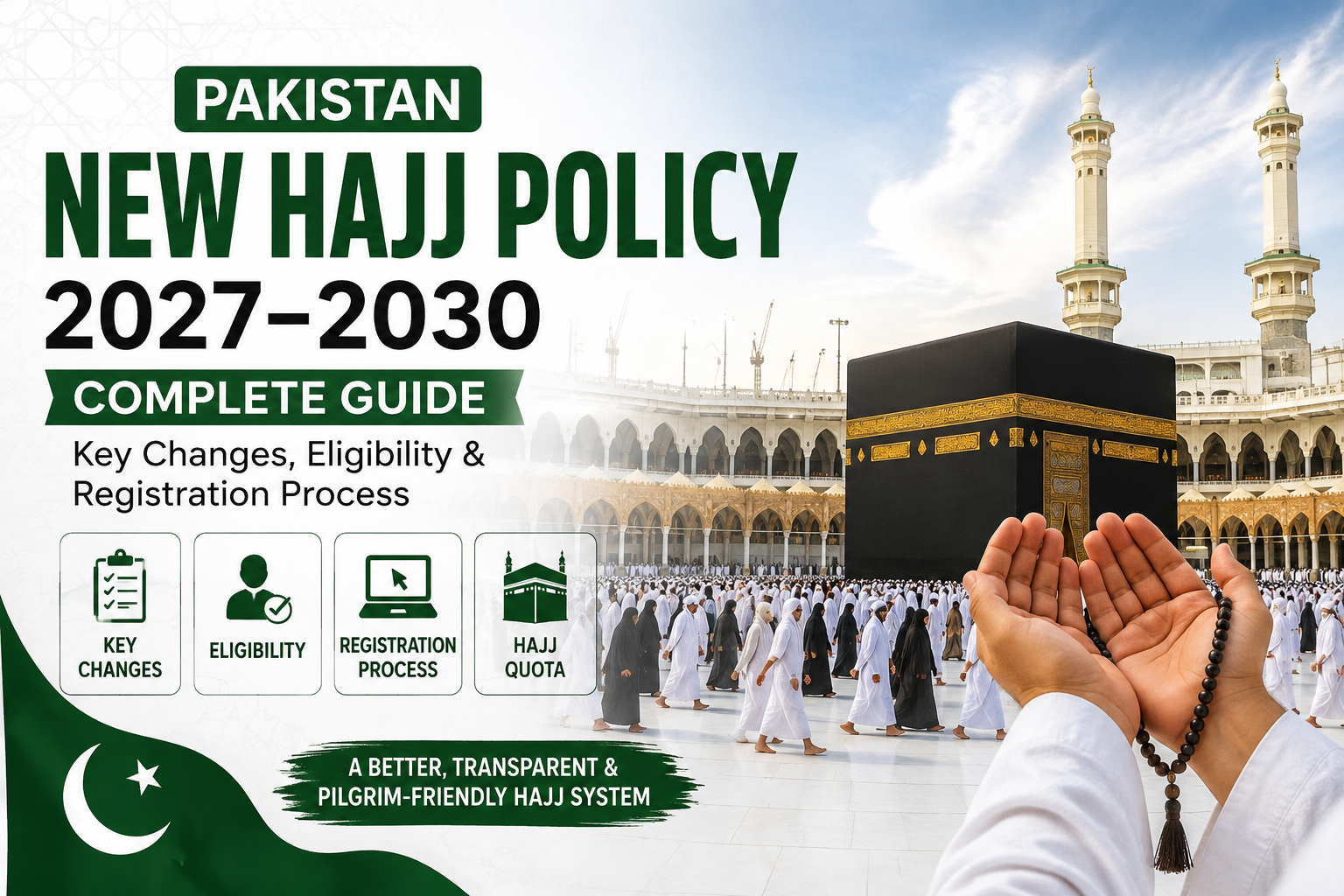
The Government of Pakistan has introduced a historic Pakistan new Hajj Policy 2027–2030, replacing the previous annual Hajj policy with a comprehensive four-year framework. The new policy aims to improve transparency, simplify the registration process, enhance digital services, and provide better facilities for Pakistani pilgrims. It also introduces long-term planning that allows intending pilgrims to prepare for Hajj years in advance.
One of the biggest changes is the introduction of continuous Hajj registration through 2030, eliminating the need for annual re-registration. The policy also strengthens the role of the private sector while maintaining government oversight to ensure quality services. In addition, the government plans to launch a Shariah-compliant Hajj Savings Scheme, making it easier for Muslims to save for their pilgrimage over time. Overall, the new Hajj policy is designed to make the Hajj journey more organized, transparent, and convenient for every Pakistani citizen.
Pakistan New Hajj Policy 2027–2030
The Pakistan Hajj Policy 2027–2030 is the country’s first long-term Hajj framework. Instead of announcing a new policy every year, the government has introduced a four-year plan that will remain effective from 2027 to 2030. This approach provides greater certainty for pilgrims, Hajj operators, and government departments involved in Hajj management.
The policy introduces continuous Hajj registration, allowing eligible applicants to register in advance without completing a new registration every year. Pilgrims will also benefit from improved digital services, better planning, mandatory training sessions, and enhanced operational management. Documents can must be needed and passport for essential to travel for hajj. The government has allocated 60% of the national Hajj quota to the Government Hajj Scheme and 40% to licensed private Hajj operators, ensuring both public and private sectors play an important role in serving pilgrims.
Key Changes in the New Hajj Policy
- Pakistan has introduced its first-ever four-year Hajj Policy (2027–2030).
- Annual Hajj policy announcements have been replaced with a long-term framework.
- Continuous Hajj registration has been introduced through 2030.
- Pilgrims no longer need to complete fresh registration every year.
- The Hajj quota has been divided into 60% Government Scheme and 40% Private Scheme.
- A fully digital registration and management system will improve transparency.
- Pilgrims will receive mandatory Hajj training before departure.
- The government plans to introduce a Shariah-compliant Hajj Savings Scheme.
- Long-term planning will improve accommodation, transportation, and overall Hajj services.
- Greater monitoring of private Hajj operators will help maintain service quality and protect pilgrims’ rights.
Eligibility Criteria Hajj under the new policy, applicants generally need to:
- Be a Pakistani citizen with a valid passport.
- Meet the health and vaccination requirements announced by Saudi authorities
- Registration can must needed to perform the hajj.
- Pay the required Hajj package amount according to the selected scheme.
- Follow all guidelines issued by the Ministry of Religious Affairs and Interfaith Harmony.
- Attend mandatory Hajj training sessions before departure.
Visionary Institute of Nursing Sukkur Admission 2026 NTS Apply Online
Hajj Registration Process
The registration process under the new policy has become more organized and digital.
- Register through the official Hajj registration system.
- Choose your preferred Hajj year and scheme.
- Submit the required personal information and documents.
- Deposit the prescribed registration amount according to government instructions.
- Wait for confirmation and further announcements.
- Complete remaining payments within the official schedule.
- Attend the compulsory Hajj training program before travel.
Government vs Private Hajj Scheme
The new policy clearly defines the distribution of Pakistan’s Hajj quota.
Government Hajj Scheme
- Managed by the Ministry of Religious Affairs.
- Best and cheap package in new policy of Pakistan.
- Government supervision throughout the process.
Private Hajj Scheme
- Operated by licensed private Hajj operators.
- Best opportunities and best option for chose the cheap package.
- Strict government monitoring to ensure service quality.
Benefits of the Pakistan New Hajj policy 2027-2030
Pakistan new Hajj policy 2027-2030 offers several important advantages for Pakistani pilgrims.
- Better planning for future Hajj seasons.
- Greater transparency in registration and selection.
- Improved digital services and online management.
- Reduced confusion through long-term policy stability.
- Better accommodation and transportation planning.
- Enhanced monitoring of Hajj operators.
- Easier financial planning through the proposed Hajj Savings Scheme.
- Improved training for first-time pilgrims.
- best facility and best gaudiness
FAQs
1. What is the Pakistan New Hajj Policy 2027–2030?
The Pakistan New Hajj Policy 2027–2030 is a four-year framework introduced by the Government of Pakistan to improve Hajj management, simplify registration, enhance transparency, and provide better services for pilgrims.
2. What are the major changes in the new Hajj Policy?
The policy introduces continuous Hajj registration, a four-year planning system, a 60:40 government-to-private Hajj quota, improved digital services, mandatory pilgrim training, and a proposed Shariah-compliant Hajj Savings Scheme.
3. Who is eligible to apply under the new Hajj Policy?
Pakistani citizens with a valid passport who meet the health and vaccination requirements and complete the official Hajj registration process are generally eligible to apply.
4. How can I register for Hajj under the new policy?
Applicants can register through the official Hajj registration system announced by the Ministry of Religious Affairs, submit the required documents, and complete the payment process according to the official schedule.
5. What is the government and private Hajj quota under the new policy?
Under the Pakistan New Hajj Policy 2027–2030, 60% of the Hajj quota is allocated to the Government Hajj Scheme, while 40% is reserved for licensed private Hajj operators.
Conclusion
The Pakistan New Hajj Policy 2027–2030 represents one of the most significant reforms in the country’s Hajj management system. By introducing a four-year policy, continuous registration, improved digital services, mandatory training, and better coordination between the government and private sector, Pakistan aims to provide a smoother, more transparent, and pilgrim-friendly Hajj experience. Muslims planning to perform Hajj in the coming years should stay updated with announcements from the Ministry of Religious Affairs, complete their registration on time, and prepare early to benefit from the new system. This is the most sacrifice and finical strong man can perform the hajj. With these reforms, the government hopes to make Hajj more accessible, efficient, and well-organized for every Pakistani pilgrim.